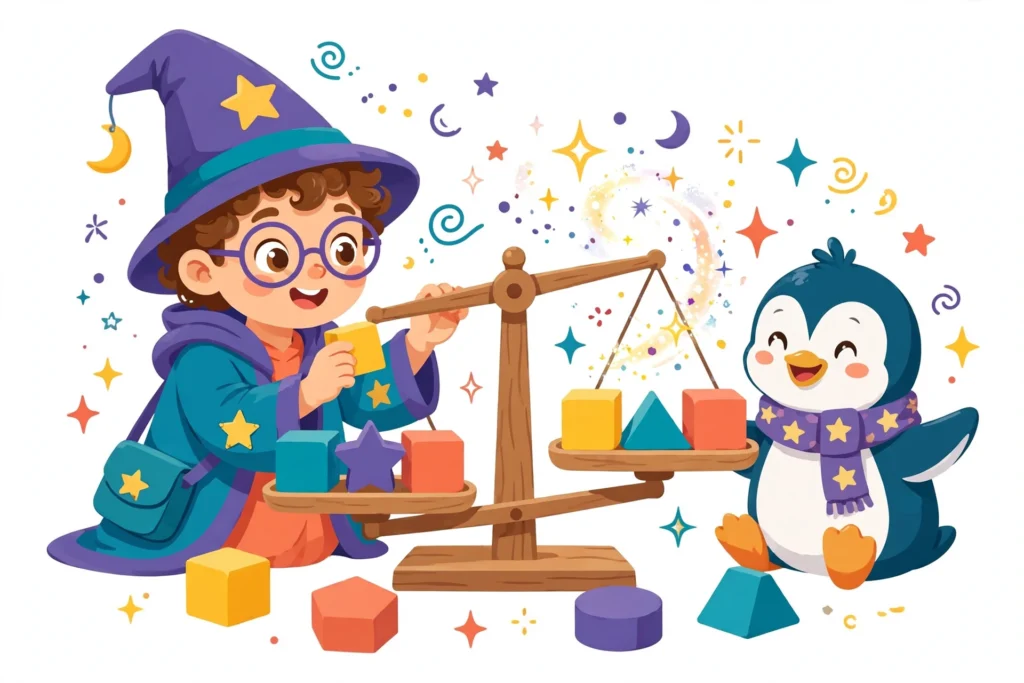
Prodigy Math and ST Math are two of the most popular math programs in schools, but they teach math in very different ways. Prodigy is a fantasy game for grades 1 to 8 where a child plays as a wizard, answers adaptive questions, and earns pets and gear. ST Math is a visual program for grades PreK to 8 where a child solves puzzles with pictures and animations, with almost no words, until they understand the idea. If your child needs motivation and a wide range of topics, Prodigy is the pick. If your child struggles to understand math ideas and needs to see them, ST Math is the pick.
What each one is
Prodigy Math is a role playing game. Children play as a wizard, explore a fantasy world, and answer math questions to win battles and earn pets and gear. The questions adapt to the child level and cover the full curriculum, from counting and place value to fractions and algebra basics. A teacher or parent can set which topics appear, and a free teacher dashboard shows how each child is doing. The game is free to play, with an optional parent membership for extra game items.
ST Math is a visual learning program made by MIND Education. It teaches math with puzzles, pictures, and animations. A child plays as JiJi the penguin, moves blocks and shapes to solve a puzzle, and sees at once whether the answer works. There are almost no words and no numbers to start with, so a child who struggles with reading or with English can still learn the math idea. The full introduction is in What is ST Math.
How they practise math
Prodigy practises math inside a game. A question appears as part of a battle, the child answers, and a correct answer casts a spell. The game adjusts difficulty as the child plays, so a struggling child gets easier questions and a strong child gets harder ones. The practice feels like play, which is why reluctant students often do more of it, and the questions cover new topics, not just facts.
ST Math practises math through visual puzzles. A child sees a problem as a picture, moves the pieces to solve it, and the animation shows whether the move was right. If the move was wrong, the child tries again and sees what changed. The program does not give the answer in words: the child has to work out the idea from what they see. That makes it slow at first, but the understanding lasts, because the child built the idea themselves.
Cost compared
| Feature | Prodigy Math | ST Math |
|---|---|---|
| Free version | Yes, full game is free to play | No free version, short trial only |
| Paid version | Optional parent membership for game extras | Paid subscription, per student or per school |
| Ads | No ads in the game | No ads |
| Teacher cost | Free teacher dashboard | Paid, often bought by the school |
| Grades | Grades 1 to 8 | Grades PreK to 8 |
The cost difference is the clearest one. Prodigy is free to play, with a paid extra that is not needed to practise math. ST Math is a paid program, and a parent usually cannot buy a single student licence easily: it is sold to schools and districts. If cost is the deciding factor, Prodigy wins. If a school already pays for ST Math, the child should use it for visual learning.
Grades and ages
The grade ranges overlap from grade 1 to 8, and that is where the choice matters most. ST Math covers grades PreK to 8 and is strongest in grades PreK to 5, when children are building their first ideas about numbers, shapes, and fractions. Prodigy covers grades 1 to 8 and is strongest across the whole elementary range because it teaches topics with adaptive questions. A PreK or kindergarten child starting out will get more from ST Math, and the grade guides on this site show what Prodigy covers at that level, for example Prodigy Math for Grade 1. A 4th grader who knows the facts but does not understand fractions should use ST Math for a few minutes a day on top of Prodigy.
In the classroom
Teachers use the two tools for different moments. Prodigy works as a station activity, a warm up, or daily practice: the teacher sets a topic, each student practises at their own level, and the dashboard shows who needs help. ST Math works as a lesson in itself: the teacher introduces a puzzle, the class works through it together, and each student practises the same idea at their own pace. It is easy to run because the program gives feedback on its own, and the teacher can see which ideas each student has mastered. In class, the two tools do not compete: Prodigy teaches the topics with questions, ST Math builds the understanding with pictures, as shown in Prodigy Math vs 99math.
For homework and home practice
At home, the difference is motivation and access. A child will often open Prodigy without being asked, because it is a game with a world to explore, and a session can run for half an hour. ST Math at home is a focused job: the child does it because a parent asks, and it takes only a few minutes. That is its strength: it is easy to fit in every day. If the goal is practice that happens on its own, Prodigy wins. If the goal is a deeper understanding of a hard idea, ST Math wins, when the school provides it.
Which one should you pick
Pick ST Math if the child is in grades PreK to 5, if they struggle to understand math ideas, if they are learning English, or if the school already pays for it. Pick Prodigy if the child needs to learn new topics, if they avoid math practice, or if a teacher needs to track progress across the curriculum. In the overlap years, grades 1 to 8, use both: ST Math for a few minutes of visual puzzles, then Prodigy for the main practice. Neither tool teaches a brand new concept well on its own, so pair either one with a teacher, a video lesson, or a parent explaining the idea first.
Frequently asked questions
Is ST Math better than Prodigy?
For visual understanding, yes. ST Math is built to show math ideas with pictures and puzzles, so a child who struggles with words can still learn. For motivation, range of topics, and teacher tracking, Prodigy is the better pick.
Can you use Prodigy and ST Math together?
Yes. Many parents and teachers do: ST Math for a few minutes of visual puzzles, then Prodigy for the main practice and for new topics.
Is ST Math free?
No, ST Math is a paid program, usually bought by schools. It offers a short trial, but the full program needs a subscription.
Is Prodigy free?
Yes, the game is free to play. An optional parent membership adds game extras, but it is not needed to practise math.
Which is better for elementary school?
Both fit elementary school, in different ways. ST Math is better for building visual understanding in grades PreK to 8. Prodigy is better for covering the full curriculum, adapting to each child, and giving teachers progress data.
Related guides
This site is an independent guide. It is not the official Prodigy site, and it is not affiliated with Prodigy Education.