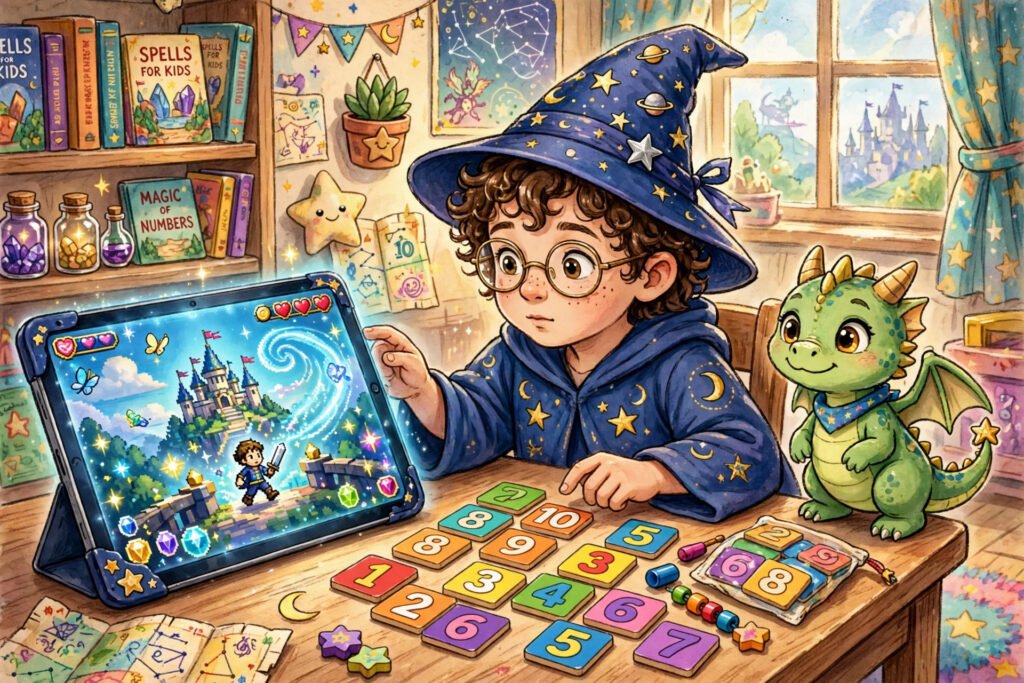
Prodigy Math and Osmo both make math feel like play, but they play in opposite ways. Prodigy is a free to play online fantasy game for grades 1 to 8, where children answer adaptive math questions inside battles, quests, and pet adventures. Osmo is a hands on system that turns an iPad or Fire tablet into a tabletop game, using a base, a reflector, and physical pieces that children move with their hands, with games such as Numbers, Tangram, and Words. If your child needs a lot of math practice and will happily play a game on a screen, Prodigy is the pick. If your child is young, learns by touching and moving things, and you want less pure screen time, Osmo is the pick. Many families use both, Osmo for the early years and Prodigy for the years after.
What each one is
Prodigy Math is a role playing game. Children play as a wizard, explore a fantasy world, and answer math questions to win battles and earn pets and gear. The questions adapt to the child level and cover the full math curriculum, from counting and place value to fractions and algebra basics. A teacher or parent can set which topics appear, and the game is free to play, with an optional parent membership for extra game items.
Osmo is a hands on learning system, not a game you only watch. A base and reflector clip onto a tablet, and children play with real pieces on the table, such as number tiles, tangram shapes, and letter tiles, while the tablet camera reads what they do. The games cover early math, spelling, drawing, and coding, and the experience is physical: a child picks up a tile, moves it, and sees the screen respond. For another full platform comparison, see Prodigy Math vs IXL.
How they teach math
Prodigy teaches math through volume. A child can answer dozens of questions in one session without noticing, because every question is part of a battle or a quest, and the game adjusts the difficulty as the child plays. The practice covers new topics, not just review, and the teacher dashboard shows which topics are weak. It is deliberate practice hidden inside a game, and it works best for children who can already read the questions and sit with a screen for twenty minutes or more.
Osmo teaches math through touch. In Osmo Numbers, a child places number tiles to reach a target, adds and multiplies by moving pieces, and sees the result at once. The learning is concrete, which suits young children who still need to hold a number in their hand before they can hold it in their head. The math is simpler and the sessions are shorter, because the games are built for younger children and the physical pieces set a natural pace. Osmo builds number sense; Prodigy builds fluency across the whole curriculum.
Cost compared
| Feature | Prodigy Math | Osmo |
|---|---|---|
| Free version | Yes, full game is free to play | No, needs a starter kit |
| Paid version | Optional parent membership for game extras | Starter kit plus add on game sets |
| Device needed | Browser or app on most devices | iPad or Fire tablet, plus the Osmo base |
| Ages | Grades 1 to 8, about ages 6 to 14 | About ages 5 to 12 |
| Subjects | Math, plus a separate English game | Math, spelling, drawing, coding |
| How children play | On screen, inside a fantasy world | Hands on, moving physical pieces |
| Teacher tools | Free teacher dashboard with reports | Classroom kits and lesson ideas |
Cost is the clearest difference between the two. Prodigy is free to play, so a family can start today at no cost, on a device they already own. Osmo needs a starter kit, which includes the base and the first games, and each extra game set is another purchase, so the cost grows as the child wants more games. A family that only needs math practice would pick Prodigy. A family that wants hands on play and is happy to pay for the hardware may find Osmo worth it, especially for a younger child.
Ages and stages
Osmo is strongest with younger children, about ages 5 to 8, where moving tiles and building shapes is the learning itself. A five year old can play Osmo Numbers with no reading at all, which is something no screen only math game can match. Prodigy is strongest from about age 7 upwards, when a child can read the questions and follow a quest, and it keeps going through grade 8, long after a child has outgrown Osmo. The two tools hand over to each other: Osmo for the early years, Prodigy for the years after. For another comparison aimed at younger children, see Prodigy Math vs ABCmouse. A child in grade 3 to 5 can use either one, and the choice comes down to how the child learns, by touching things or by playing a game.
Screen time and hands on play
Screen time is where parents feel the difference most. Prodigy is a screen game, so a session is screen time, and parents who worry about that should set a timer and a clear stopping point, as with any game. Osmo is also on a tablet, but the child looks at the table as much as the screen, because the play happens with the hands, which makes it feel less like pure screen time and more like a tabletop game. Neither tool is screen free, so the question is not which one has no screen, but which kind of screen time fits your child. A child who sits still for a game will do well with Prodigy. A child who needs to move, touch, and build will do better with Osmo, and will probably play it longer.
In the classroom and at home
Teachers use the two tools for different moments. Prodigy works as a station activity, a warm up, or homework: the teacher sets a math topic, students practise it in the game, and the reports show who needs help. It scales to a whole class with no extra hardware, because it runs on whatever devices the school already has. Osmo works as a small group station, because the base and pieces are shared by two or three children at a time, which makes it great for early years classrooms and less practical for a whole class at once. At home the same split applies: Prodigy is the daily practice tool, Osmo is the weekend tabletop game. The wider comparison across math games is in Prodigy Math vs other math games.
Which one should you pick
Pick Osmo if your child is 5 to 8, learns by touching and moving things, and you want the first math tool to be physical. Pick Prodigy if your child is 7 or older, needs a lot of math practice, or will only practise willingly inside a game. At home, the choice is often both: Osmo for the early years and for hands on play, Prodigy for the daily math reps that carry a child through grades 1 to 8. If the budget only allows one, and the need is math practice for a child in grade 2 or above, Prodigy is free and it is the pick.
Frequently asked questions
Is Osmo better than Prodigy?
For young children and hands on learning, yes. Osmo suits ages 5 to 8 and children who learn by moving physical pieces. For math practice across grades 1 to 8, Prodigy is the better pick.
Can you use Prodigy and Osmo together?
Yes. Many families do: Osmo for hands on number sense in the early years, and Prodigy for daily math practice from about age 7 onwards.
Is Osmo free?
No. Osmo needs a starter kit with the base and reflector, plus the games you want to play. Each extra game set is a separate purchase.
Is Prodigy free?
Yes, the game is free to play. An optional parent membership adds game extras, but it is not needed to practise math.
What ages is Osmo for?
Osmo is aimed at about ages 5 to 12, and it is strongest with children aged 5 to 8. Older children usually move on to screen based games such as Prodigy.
Related guides
This site is an independent guide. It is not the official Prodigy site, and it is not affiliated with Prodigy Education.