
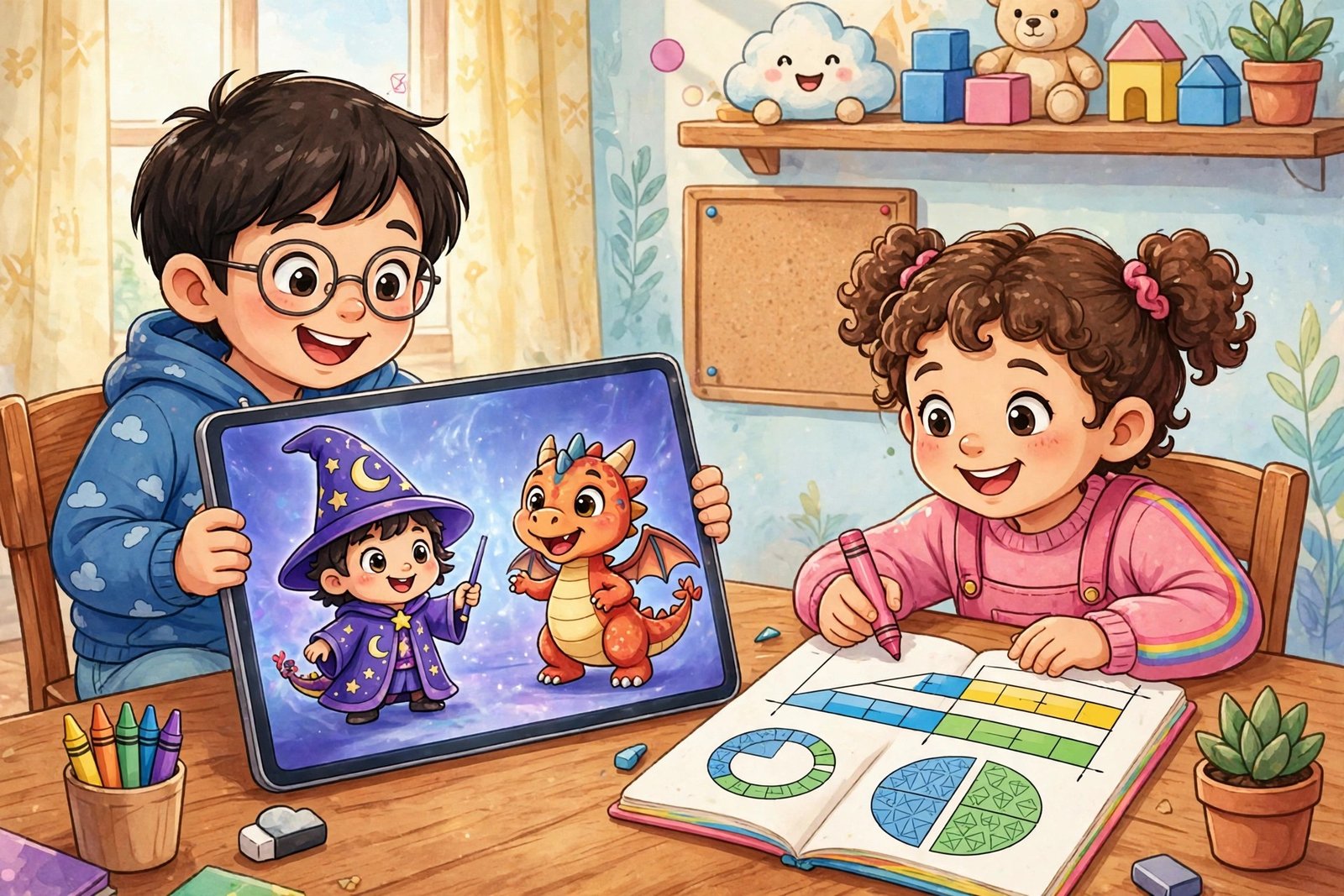
Your child opens the maths homework and you see a bar drawn across the page, split into coloured blocks, with a question that asks for the missing part instead of a plain sum. Nothing about it looks like the maths you learned at school, and the workbook offers no worked example you can follow. That same evening the child begs for twenty more minutes on Prodigy, where every question has a clear answer and a dragon waits at the end. One page feels like a puzzle in a foreign language, the other feels like a game with a reward after every question, and you are left wondering which one is actually teaching maths and which one is only keeping your child busy. That worry is fair, because the two products do very different jobs, and picking the wrong one for the wrong job wastes a whole school year. So which one deserves your time, and which one should you simply understand and leave to the teacher? This prodigy math vs math in focus guide answers that question in plain language. Prodigy Math is a free to play fantasy game for grades 1 to 8 where a child plays a wizard, answers adaptive maths questions to win battles, and collects pets and gear. Math in Focus is a full school maths curriculum for kindergarten to grade 8, the U.S. edition of the Singapore Math curriculum, written by Marshall Cavendish and published in the U.S. by Houghton Mifflin Harcourt, taught from textbooks and workbooks with lessons, practice and tests for every school day. If you are a parent looking for free practice at home, Prodigy is the stronger pick. If your child school has chosen Math in Focus and you want to understand the bar models in the homework, Math in Focus is the program to learn about, and Prodigy is the practice that sits beside it. The rest of this guide shows you why that split holds, what each one costs, and how to use both without doubling the homework load.
What each one is
Prodigy Math is a role playing game first and a maths tool second. A child creates a wizard, explores a fantasy world, and answers maths questions to win battles, earn gear and collect pets. The questions adapt to the child level and cover about 1,400 skills across grades 1 to 8, from counting and place value to fractions and pre algebra basics. A parent or teacher can set which topics appear, and the game is free to play, with an optional parent membership for extra game items. The maths itself never sits behind the paywall. Children play it because it feels like a game, not because it feels like school, and that feeling is the whole point of Prodigy. It turns practice into play, and for a child who avoids maths, that change alone can be worth a great deal. The game lives at home, on a screen, and it asks for no travel, no timetable and no other person in the room. A child can open it after school, play for fifteen or twenty minutes, and close it again without a parent having to drive anywhere or sit through a lesson. Parent and teacher dashboards let an adult check progress, set topics and see where the child is strong or weak, all without paying anything for the maths.
Math in Focus is a very different kind of product, and it helps to picture it clearly before you compare prices or results. Math in Focus is the U.S. edition of the Singapore Math curriculum, written by Marshall Cavendish and published in the United States by Houghton Mifflin Harcourt. A school adopts it as the maths program for the whole year, which means the teacher plans every lesson from it, the children work from its textbooks and workbooks, and the tests come from it too. The program covers kindergarten to grade 8, and it follows the Singapore approach that the publisher describes as a highly effective teaching method originally developed by Singapore Ministry of Education in the 1980s. That approach rests on three ideas you will see in every chapter: the concrete pictorial abstract progression, which moves a child from real objects to pictures to symbols; number bonds, which show how numbers split and join; and bar modeling, which draws a problem as bars so the child can see the parts before doing the sums. The books come with teacher guides, assessments and workbooks beside the main student books, and the program expects a teacher to lead each lesson. Math in Focus is not a game a child chooses. It is the maths course a school chooses, and that difference shapes everything that follows. But a program description never shows how a lesson actually feels day to day, so let us look inside the teaching next.
How the teaching works
Prodigy teaches through play and repetition. A question appears as part of a battle, the child answers, and a correct answer casts a spell. The game adjusts difficulty as the child plays, so a struggling child gets easier questions and a strong child gets harder ones. The practice feels like play, which is why reluctant students often do far more of it than they would with a workbook. A child can answer dozens of questions in one sitting without noticing the count, because each question is a step toward a pet or a piece of gear. That volume is the greatest strength of Prodigy, because fluency grows when a child meets the same kind of question again and again until the answer comes fast. But the game cannot explain an idea the way a person or a good book can, and it cannot tell why a child made a mistake. It can only ask the question again later. Prodigy is strongest as practice and motivation, not as a first teacher of new ideas, and a parent who expects the game to teach a brand new topic from zero will be disappointed. The game is also strongest when a parent or teacher sets the topics, so the questions match what the child is learning at school. Left on its own, it will practise widely. Guided well, it will practise exactly the skill your child needs this week.
Math in Focus teaches through a planned lesson that a teacher leads, and the structure is the same every day so children know what to expect. A chapter opens with a problem to think about, then the lesson moves through engage and learn, a hands on activity, a try it step, independent practice, math talk and math sharing, games, a math journal entry, a thinking cap challenge, a chapter wrap up and a chapter review, with assessment preparation and a performance task at the end. The publisher says the method is focused on mastery, with sequencing that returns to topics over the course of years, each time building complexity and depth. A child who meets fractions with real objects in one year, then as pictures the next, then as symbols and bar models later, builds the idea slowly and keeps it. That slow build is the real example that proves the design. In one Singapore math comparison, Math in Focus was rated the priciest of the four Singapore programs, with about 17 activities in a chapter, and a reviewer put its cost at 200 to 300 dollars per grade level, while also calling it the least homeschool friendly of the lines because it has no home instructor guide and expects a teacher to lead. If you want a comparison with a program that teaches through stories and ideas rather than game volume, read Prodigy Math vs Singapore Math. The teaching question is really a control question. Who chooses the work, the child or the teacher? Your answer to that question points straight at the right product. But teaching is only half the decision, because one of these options costs money and the other does not, so let us compare the real cost next.
Cost compared
| Feature | Prodigy Math | Math in Focus |
|---|---|---|
| Free version | Yes, full game and all maths free to play | No free version, schools buy the books |
| Free trial | None needed, free to play from the start | Sample pages and previews from the publisher |
| Paid cost | Optional membership for game extras only | About 200 to 300 dollars per grade level, per one reviewer |
| Publisher price | None, the game is free to play | Not listed on the publisher program page |
| Teacher tools | Parent and teacher dashboards included | Teacher guides, assessments and workbooks |
| Who assigns the work | Child chooses, parent or teacher can set topics | Teacher plans every lesson from the program |
| Grades | Grades 1 to 8 | Kindergarten to grade 8 |
| Best for | Free motivation and practice volume at home | A full school maths course with Singapore method teaching |
Cost is the sharpest difference between these two, and it deserves a plain look. Prodigy is free to play, so a family can start today at no cost and the maths never asks for a card. An optional membership adds game extras only, such as extra pets and gear, and it is not needed to practise maths. Math in Focus works the other way round. A school buys the books for its classes, and the price depends on how many grades, students and books the school needs. One Singapore math reviewer puts Math in Focus at 200 to 300 dollars per grade level, and a Singapore math comparison rated it the priciest of the four Singapore programs it compared, while the publisher does not list a price on its program page, so a school must ask for a quote. Each grade needs two student books, several workbooks, assessments and two teacher guides, which is why the per grade cost climbs above the cheaper Singapore lines. A family comparing the two at home has an easy decision. Prodigy costs nothing for the maths, so the risk of trying it is zero. A family can try Prodigy for two weeks, watch the child, and lose nothing if it does not fit. A school comparing the two has a different decision entirely, because Math in Focus asks for a real budget line and a multi year commitment, while Prodigy asks for nothing and fits beside any program. That is why the honest question for a parent is not which one is cheaper. The question is which job you are buying for: a full course for a school, or free practice for one child at home. Price means little if the program does not fit your child age, so let us check grades and levels next.
Grades and ages
Prodigy covers grades 1 to 8, and it is strongest across the whole elementary range and into middle school because it teaches topics, not only facts. A child in grade 1 can play it, and a child in grade 8 can still find questions at their level. The game follows the child, so a younger child gets gentle questions and an older child gets harder ones, all inside the same fantasy world. The parent can set the grade level and the topics, so the game can match school work or fill a gap from an earlier grade. That flexibility matters for a child who is behind in one topic and ahead in another, because the game can practise each topic at its own level. Prodigy never claims to cover high school, and it should never be judged as a high school program. It is a grades 1 to 8 practice game, and inside that range it is broad, covering about 1,400 skills from counting, arithmetic, fractions, geometry, measurement and data, through to pre algebra basics as the child grows.
Math in Focus covers kindergarten to grade 8, and that full span is its greatest strength and its greatest demand. A child can start with it in kindergarten, keep the same approach through elementary school and into middle school, and the method stays the same at every step: real objects first, then pictures, then symbols, with bar models carrying the thinking all the way through. That continuity matters, because each year builds on the words and methods the child learned the year before, and nothing has to be relearned in a new style. The middle school years, grades 6 to 8, are where the program meets Prodigy head on, and the early years are where Math in Focus stands alone, because Prodigy starts at grade 1 and does not teach a five year old. A parent should also notice the limit that comes with that span. A full curriculum expects a teacher, a timetable and a class. It is not built for a child to open alone at the kitchen table and teach themselves, and a parent who buys the books without a teacher will find a course, not a game. Age is only half the story though, because a child who is behind needs the opposite of a child who is ahead.
For a struggling student
For a child who is falling behind, the choice is harder than it looks, because both programs can help and both can hurt if they are used in the wrong order. Prodigy is usually the safer first step for a child who has lost confidence. A wrong answer in a game is just a lost battle, not a failed test, and the game quietly drops the difficulty until the child succeeds. The child keeps playing because the game keeps rewarding effort, and the maths practice piles up without a fight. A child who has decided they are bad at maths needs wins first, and Prodigy is built to give wins. You feel torn here, and that feeling is honest: you want to help, you fear choosing wrong, and you worry that every week of delay makes the gap wider. That worry is real, and it is why the order matters more than the brand. Give the struggling child wins first, understanding second, and routine third, and the confidence will follow.
Math in Focus can also help a struggling child, but in a different way and at a different time. Because the method moves from real objects to pictures to symbols, a child who cannot follow the symbols yet can still work with the objects and the pictures, and the bar model gives the child something to see instead of a bare sum to fear. The program revisits topics over years with growing complexity, so a child who missed one idea gets more chances to meet it again in new forms instead of watching the class move on the next morning. But the same depth can hurt a child who is already behind, because a lesson with about 17 activities asks for focus and patience, and a child who dreads maths may switch off long before the practice starts. A child who needs lots of gentle wins will get them from Prodigy in a way a textbook cannot match for sheer fun, yet a child who needs a teacher to slow down and rebuild one idea from real objects will get that slow rebuild from Math in Focus in a way a game cannot match for depth. The wise order is often Prodigy first to rebuild the habit and the confidence, then the classroom program to rebuild the understanding once the child is willing to sit with a lesson again. Watch your child for two weeks on the free option before you commit money to the paid one, and let the child reaction guide you. But what if your child is not behind at all, and the problem is the opposite?
For an advanced student
For a child who is ahead, neither product is a complete answer on its own, and Prodigy alone will not be enough. An advanced child does not need more easy questions. They need speed, challenge and a path that moves forward without waiting for the class. Prodigy adapts upward, so a strong child will get harder questions, but the game will never teach a brand new idea from zero, and it stops at grade 8. An advanced child who only plays Prodigy may stay fluent and still feel bored, because fluency is not the same as depth. Math in Focus has a longer runway for this child inside its own range. It runs from kindergarten to grade 8 with the same method, so an advanced child can move through topics faster, meet harder thinking cap challenges, and build the bar model habit that carries into algebra later. The deep study of fewer topics suits a strong child too, because the program asks for reasoning and explanation, not only quick answers.
For the advanced child, the best mix is often the school program for the forward push plus Prodigy for daily fluency. Math in Focus gives the new ideas, the harder problems and the tests that prove mastery, while Prodigy keeps the basics sharp with quick daily practice and gives the fun break between harder sessions. If your school uses Math in Focus, ask the teacher which topics the class will reach this term, and set Prodigy to the same topics so the game reinforces the lesson instead of drifting away from it. If you want another game first option to compare before you decide, read Prodigy Math vs Matific. The worry many parents feel here is real: what if I push my child ahead and they miss the basics? The answer is to watch the work, not the grade level. If your child finishes the Math in Focus practice fast and explains each answer clearly, they are ready for the next step. If they guess fast and cannot explain why, they need more practice at the same level, and Prodigy is the pleasant way to give it. So how does each one fit into a real classroom week?
In the classroom
In the classroom, Math in Focus is built for the teacher, and that is where a math in focus review finds its clearest strength. A teacher plans the year from the program, opens the teacher guide each morning, and teaches the lesson the program sets out. The class opens with a problem to think about, works through the learning steps together, practises in the workbooks, talks about the maths in math talk and math sharing, and finishes with a chapter review and a performance task that shows who understood and who needs help. The assessments match the lessons, so the teacher can see exactly which idea needs another look before the class moves on. The program is the course, not an extra, and the teacher time goes into teaching, not into hunting for material. The cost of that structure is preparation, because the method asks the teacher to learn the Singapore approach properly, and reviewers are clear that the program is not open and go without its teacher guide.
Prodigy in the classroom works differently, and it works best as free practice beside the lesson rather than as the lesson itself. A teacher can set the topics for the class, watch the teacher dashboard, and let children play for ten or fifteen minutes after the main teaching is done. The game needs almost no teacher time, which is why busy teachers like it. A child can play after the lesson, the maths happens, and the teacher can help another child in peace. There is no licence to buy and no quote to request, because the maths is free to play for grades 1 to 8. To set up your class the right way, follow the Prodigy for Teachers: Class Setup Guide, which walks through creating the class, adding students and choosing the topics that match your week. The honest test is your week, not your wish. Look at the last seven days, count the lessons where you needed a full course with a textbook and a test, and count the lessons where you needed ten minutes of free practice that children actually wanted to do, and pick the tool that fits the week you actually teach. So with all of that in mind, which one should you actually pick?
Which one should you pick
Pick Math in Focus if your school has adopted it as the maths course, or if you are a teacher or school leader choosing a full curriculum for kindergarten to grade 8 with textbooks, teacher guidance, workbooks and tests, and if your school can pay for the books after asking the publisher for a quote. Pick Prodigy if your child avoids maths practice, needs motivation, is behind grade level, or you need something that starts today with no setup and no cost. Pick both if you want the best of each: Math in Focus for the course and the teaching, Prodigy for the fun and the motivation at home. That pairing is the answer some families and teachers land on, and it works because the two products cover the weak spots of each other. Math in Focus gives structure, depth and the Singapore method that builds real understanding. Prodigy gives choice, volume and joy. Math in Focus gives the lesson and the test. Prodigy gives the practice that feels like play. Use Math in Focus in class for the lessons and the assessments, and Prodigy for ten or fifteen minutes a day at home for extra practice on the same topics, and ask the school for the per grade price before you promise your district a number, because a program fee should never be a surprise. Do not judge Math in Focus by one hard homework page, and do not judge Prodigy by one happy evening. Judge each one by the week: did the lessons make sense, did the practice happen without a fight, and did the child explain one new idea clearly by Friday? If your child finally does maths without a fight because of Prodigy, that is also your answer, and you have already won. The honest trade is simple: Math in Focus gives a full course with a teacher and a textbook for kindergarten to grade 8 at a quoted school price, while Prodigy gives free game based practice at home for grades 1 to 8 with no person watching. Choose the trade that fits your child, your classroom, your time and your budget, not the trade that sounds best in an advert. That is the whole prodigy math vs math in focus decision in one line: pay for a full course with a teacher, or play free at home and let the game do the motivating. Start with the free one this week, ask the teacher which Math in Focus topic comes next, and watch your child for two weeks. The child will tell you which one to keep. Still unsure about one detail? The questions below answer the ones parents and teachers ask most.
Frequently asked questions
Is Math in Focus free?
No. Math in Focus is a school purchase. One Singapore math reviewer puts it at 200 to 300 dollars per grade level, and the publisher does not list a price on its program page, so a school must ask for a quote. Prodigy Math is free to play, and all of its maths is free for grades 1 to 8.
Can you use Prodigy and Math in Focus together?
Yes. Many families and teachers do: Math in Focus in class for the lessons, workbooks and tests, and Prodigy at home for free game based practice and motivation on the same topics. Set the Prodigy topics to match the lesson your child is studying, and the two support each other instead of competing.
What grades does Math in Focus cover?
Math in Focus covers kindergarten to grade 8, following the Singapore Math approach from Marshall Cavendish, published in the U.S. by Houghton Mifflin Harcourt. Prodigy Math covers grades 1 to 8 only, and it never covers high school.
Is Prodigy free?
Yes, the game is free to play. An optional parent membership adds game extras, but it is not needed to practise maths. All maths content is free for grades 1 to 8, and Prodigy never covers high school.
Which is better for a teacher?
Math in Focus is usually the better pick for a teacher who needs a full course with lessons, textbooks and tests for kindergarten to grade 8. Prodigy is usually the better pick for free practice and motivation, and many teachers use Math in Focus in class and Prodigy at home together.
Related guides
This site is an independent guide. It is not the official Prodigy site, and it is not affiliated with Prodigy Education or with Houghton Mifflin Harcourt.